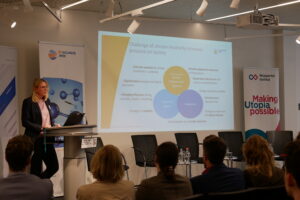
The keynote by Katja Witte (Wuppertal Institute) focused on the essential role of societal support in industrial transformation. She emphasized that people, not technology, drive change – industrial transformation only succeeds when it is fully integrated into broader processes of sustainable structural change.
Key determinants of structural change include technological progress, global shifts, demographic developments, consumption patterns, and political and institutional factors such as laws, subsidies, and infrastructure. The challenge of climate neutrality increases societal pressure, affecting areas like mobility, governance structures, energy and product prices, as well as infrastructure needs.
Katja Witte highlighted the importance of initiating opinion formation at all levels, rather than merely promoting acceptance. Robust, well-informed public opinion helps society withstand misinformation and enhances knowledge, orientation, and self-efficacy. Factors influencing acceptance include trust in actors, communication and participation, perceived risks, knowledge, media coverage, and regional experiences.
As part of SCI4climate.NRW, the Wuppertal Institute and IW Cologne analyzed potential local acceptance issues for industrial decarbonization measures in North Rhine-Westphalia. The work package combined a transformation index, municipal profiles, and interviews with stakeholders to assess the progress on energy transition, distributive justice (how costs and benefits affect communities), and procedural justice (governance, participation, trust).
Findings revealed potential acceptance challenges, including operational restructuring, impacts on employment and qualifications, construction, and landscape aesthetics. Katja Witte emphasized once again that proactive communication and cooperative governance are crucial. Institutionalized coordination between companies, local authorities, environmental associations, and civil society – through committees, information events, or open-house days – increases trust and participation.
The keynote concluded that industrial transformation succeeds when communities feel actively involved, and when companies and local stakeholders communicate and collaborate early and transparently rather than only reacting to resistance.

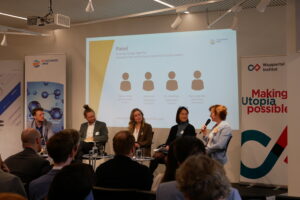
Moderated by Sandra Parthie (IW Brussels) the panel brought together Tomas Wyns (Vrije Universiteit Brussel), Soo Jung Kim (World Steel Association), Katharina Hartmann (DG ENER), and Dr. Matthias Diermeier (IW Köln) to discuss how Europe can shape its path towards industrial transformation amid global challenges.
Speakers emphasized that today’s industrial policy is not only about transformation but also about ensuring industrial survival. While five to eight years ago there was strong momentum behind the green transformation, today many projects have been cancelled amid new geopolitical and economic realities.
Participants highlighted several external pressures: the war at the European border, fierce competition from China – which follows a long-term, strategy-driven approach across entire value chains – and an unpredictable policy environment in the United States. Against this backdrop, the urgency for transformation within the European Union is growing, calling for decisive measures and long-term resilience strategies.
The EU’s Net Zero Industry Act and the concept of Net Zero Industrial Valleys were cited as examples of new frameworks that increasingly include local communities in industrial planning. In several countries, such as Denmark and Greece, community consultation is already mandatory. Energy communities, in which citizens jointly invest in energy projects, were described as vital for building trust and ownership – as demonstrated by successful cases like Saerbeck in Germany.
Despite rising skepticism – around one in five Germans now oppose climate action, and populist parties are capitalizing on these divisions – public support for industrial transformation remains strong overall. Panelists stressed that engaging citizens early and transparently can make transformation processes more inclusive and sustainable.
From an international perspective, examples from India illustrate how stakeholder expectations can accelerate progress: although India’s national goal is climate neutrality by 2060, several steel companies are targeting 2050, driven by investor and customer demand.
In discussing regional transformation, speakers called for more ex ante funding – proactive financial support for regions before crises hit – through instruments such as the Just Transition Fund and the Modernisation Fund. This approach, they argued, helps communities actively shape change rather than merely respond to its consequences.
The panel concluded that Europe must strengthen its industrial resilience through innovation in areas like industrial heat pumps and by focusing on its key strengths. The world is watching Europe’s approach closely, and strong leadership will be crucial. As one participant noted, “Public trust is lost through cowardice – leadership is what sustains it.”
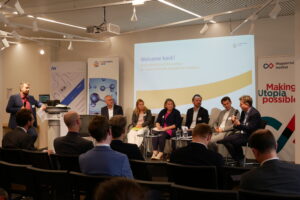
Moderated by Dr. Lukas Hermwille (Wuppertal Institute), the fishbowl discussion brought together Domenik Treß (NRW.Energy4Climate), Judith Kirton-Darling (industriAll Europe), Samuel Flückiger (thyssenkrupp Steel), and Balbina Gluza-Czyczerska (DG REGIO). With three open chairs available for spontaneous contributions, the conversation remained dynamic and inclusive – by the end of the session, all three chairs had been filled, reflecting the willingness of participants to actively engage in the dialogue.
The discussion centered on the importance of trust and ownership as fundamental conditions for a just and successful transition. Participants agreed that transformation processes fail when communication remains superficial or one-directional: If challenges arise and expectations are unmet, public trust can quickly erode. Experiences with the EU’s Just Transition Fund (JTF), the first pillar of the Just Transition Mechanism (JTM), were highlighted as an effective tool to mitigate such risks. Designed to ensure that everyone in the EU has a fair chance to benefit from opportunities stemming from the climate-neutrality transition, the JTF embodies the principle of “leaving no one behind.”
True engagement requires keeping dialogue channels open, remaining agile, and actively involving stakeholders at every stage. From an industrial perspective, panelists emphasized that transformation is not a luxury but a necessity. However, the lack of adequate infrastructure often constrains companies’ ability to stay agile and make forward-looking decisions. Ensuring framework conditions that support both innovation and investment – including industrial policy measures for a just transition – was seen as crucial.
The conversation also highlighted the local dimension of transformation. Keeping entire value chains within Europe, strengthening local content, and addressing trade-related challenges were identified as key priorities for securing competitiveness and social acceptance. Participants agreed that Europe needs to “put its foot on the pedal” — combining industrial policy, societal participation, and long-term planning to make the green transition both fair and future-proof.
